|
In This Issue...
 |
The Trouble with Free-Range Flocks |
|
|
Donnie the Duck |
|
|
The Function of the Oviduct |
|
|
Thank You to Our "Wish List" Donors |
|
|
The Opening of West Wing |
|
|
Get to Know Your Predators: The Timber Wolf/Gray Wolf |
|
|
Recommended
Viewing:
Sitting Ducks: Season 1 |
|
|
Reader Poll #21
|
|
All
The Opening of West
Wing
Between
cleaning pens, transplanting trees, digging trenches, hog ringing
aviary nets, building ponds, raising fences and keeping our guests
comfortable and entertained, we somehow found the time to build and
open our new quarantine pen. This was a much needed addition to our
sanctuary. We want to thank Lew for donating the grassy mat that
will keep webbed feet nice and cozy and Dad for building the duck
houses.
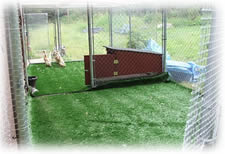
West
Wing is located at the west side of our barn. It measures 10'W x
26'L x 6'H. It is completely predator proof and a nice place for new
rescues to relax and enjoy themselves before being relocated to our
other pens.
This pen has enabled us to increase
our bio-security by raising our quarantine period from a minimum of
2 days to a minimum of 14 days. This allows us more time to observe
new ducks and geese before making the decision to move them over to
other enclosures. West Wing is hosed down on a daily basis. We keep
a 10% bleach solution in a spray bottle at the door and our gear is
cleaned as we step out of the enclosure. When birds pass quarantine
the pen is emptied and all of its contents are completely
disinfected in preparation for the next batch of rescues. These
added measures protect our waterfowl and provide a high level of
comfort and security to our adopting families.
Get to Know
Your Predators:
The Timber Wolf/Gray Wolf
The average weight
of a Timber Wolf (or Gray Wolf) is sixty pounds for a
female and seventy-five pounds for a male. As with
coyotes, they will eat anything they can take down, so
your best defense is a good offense. The same kind of
precautions taken to prevent a coyote attack should be
utilized, if not increased, if you have wolves in your
area.
Large Wolf Hounds or
Anatolian Shepherds are known to be good dogs to keep a
wolf at bay.
Recommended
Viewing*

|
Ordering
information |
Sitting Ducks:
Season One
Sitting Ducks follows the adventures of
Bill, a duck, and Aldo, an alligator. Bill's neighbors in
idyllic Ducktown, Ed, Oly and Waddle, often drag the
mismatched duo into wacky, and sometimes dangerous
adventures. Aldo shows remarkable restraint and patience
with his feathered friends, but other gators, who reside in
neighboring Swampwood, are more interested in ducks as
snacks than as pals.
Reader Poll
#21
Question: What kinds
of predators are in your area? (Check all that apply):
Results of Reader Poll #20 What kinds
of enrichment activities do you do with your ducks and
geese?
|
Giving grapes
for treats |
|
 |
|
Sprinklers |
|
|
|
|
Giving Other
Snack Treats |
|
|
|
|
Talking to
Them |
|
|
|
Contact Us
Majestic Waterfowl
Sanctuary
17 Barker Road
Lebanon, CT 06249
directorATmajesticwaterfowl.org
Our Newsletter
The Majestic Monthly is published 12 times per year. Back
issues can be obtained online from our
Newsletter Archives.
|
|
The Trouble With
Free-Range Flocks
 We
get inundated with emails from families who have suffered losses to
their flocks due to predators. Nearly all of these attacks befall
ducks and geese in free-range flocks. We
get inundated with emails from families who have suffered losses to
their flocks due to predators. Nearly all of these attacks befall
ducks and geese in free-range flocks.
It always seems to start with
someone emailing to tell us that they don't understand our concerns
about free-ranging. They tell us how their flock has been
free-ranged for a year without any losses and then further go on to
tell us they don't even have predators where they are. Understand,
there are predators everywhere, especially as we encroach
further and further on their land and diminish their hunting
resources. Predators are patient and resourceful. They will find
their moment and then they will take it.
Domestic ducks and geese don't have
teeth or claws, most cannot fly and they have little odds of
outrunning and escaping a predator that enters their yard. If a dog,
coyote, fox, weasel, fisher cat, owl, hawk, eagle or raccoon can
gain access into their yard, it is usually just a matter of time
before they will. And when they do, they often make short work of
your feathered friends.
Although first the emails tend to
come to us explaining how safe their free-range ducks and geese are,
the next emails that come are not nearly as optimistic. Sadly, most
follow-up emails in these situations are desperate. It is a terrible
thing when a predator comes and leaves only one lonely bird behind.
The other misconception is that if
duck owners have a family dog in their yard, predators will not come
in and ducks are safe. This is not true. Most dogs are
not on guard 100% of the time, right where your ducks are and fox
and coyotes have been known to raid a flock despite a dog's
presence. A fox will bide their time and wait for a dog to go inside
the house or fall asleep in the sun, while coyotes will burst right
into a yard, not fearing many dogs. Eagles and hawks are also not
thwarted by a dog.
Ducks and geese in free-range flocks
rarely die of old age; most only live a couple of years at best,
which is a shame since their life expectancies are so much longer
than this.
Flocks should ONLY be allowed
to free-range when they are directly chaperoned by a responsible
adult and can be protected from any
danger. At all other times, they should be protected in enclosures
that keep out flying, climbing, and digging predators.
Donnie the Duck
It
is not uncommon for us to get emails regarding domestic waterfowl on
ponds. Many emails come from locales far out of our reach, where we
are unable to physically assist in the rescue. In these cases it can
be difficult for us to coax the message sender to get actively
involved in the actual rescue.
Donna's email to us was much
different. She contacted us regarding two ducklings who had been
dropped off on a pond in her area. She came to us for advice on how
to catch them and for our assistance in finding them a loving home.
She took control from there.
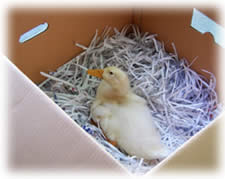 Donna
and her husband were relentless in their efforts, and although one
of the ducklings disappeared from the pond, the other duckling was
brought safely into captivity. We had someone local to her area come
in to adopt the duckling almost immediately. The adopting family was
no other than the Kentucky Huffmans! We want to thank them for
reacting on such short notice and offering the little duckling a
place in their home and hearts. They decided to name the duckling
after its rescuer, and have dubbed him Donnie. Donna
and her husband were relentless in their efforts, and although one
of the ducklings disappeared from the pond, the other duckling was
brought safely into captivity. We had someone local to her area come
in to adopt the duckling almost immediately. The adopting family was
no other than the Kentucky Huffmans! We want to thank them for
reacting on such short notice and offering the little duckling a
place in their home and hearts. They decided to name the duckling
after its rescuer, and have dubbed him Donnie.
Donna, we thank you and your husband
for your dedication and persistence in getting this little guy off
of the water. Your efforts, time and commitment saved his life. He
will forever be loved and well cared for because of your devotion to
the task. You set a wonderful example!
The Function of
the Oviduct
The ovum (egg) is released from the
ovary.
The egg enters the ostium (infundibulum).
Over the next half hour the egg is moved via contracting muscle
fibres. These contractions reduce the diameter of the oviduct and
push the egg along into the magnum region.
Within the magnum region the egg
receives a coating of albumen. This process takes approximately
three hours.
The egg moves into the isthumus
region. Here, the shell membranes are deposited on the egg. This
process takes approximately one hour.
The egg moves into the uterus region
where it receives its outer shell and pigmentation. The egg may
twist and turn as it moves through this region. It takes
approximately twenty hours for the hard outer eggshell to reach
completion.
The egg moves through the vagina and
into the cloaca and is laid.
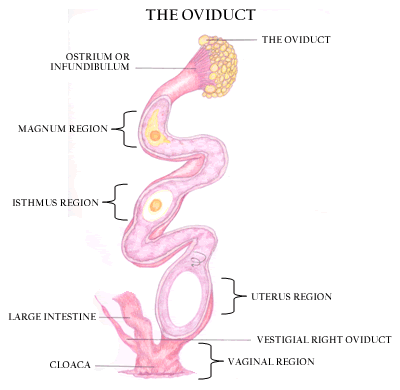
Single Oviduct
The reproductive system in birds is
usually reduced to a left ovary and oviduct. This unilateral
reduction is thought to have two major benefits:
- It reduces the bird's body
weight
- It prevents the problem of the
bird simultaneously carrying two eggs.
Hens retain a vestigial right
oviduct, which is greatly reduced in size and no longer functional
because it has become unnecessary through the course of evolution.
|