|
In This Issue...
 |
Park Rescue |
|
|
Waterfowl Lice |
|
|
Diurnal Birds of Prey |
|
|
Get To Know Your Predators: The Golden Eagle |
|
|
Calling All Fire Depts! |
|
|
The Month in Photos! |
|
|
Recommended Reading:
Manual of Ornithology |
|
|
Reader Poll #13
|
|
Calling All
Fire Departments!
Be a Water Sponsor Today!

When the rain
stops, our feathered friends need support they can count on.
When our stream
stops flowing in the heat of summer and our Courtyard pond begins to
dry up, our flock needs some serious help. Water stagnation can pose
a serious health threat to our ducks and geese.
To date, we have
not found a fire dept willing to deliver water in exchange for a
reasonable donation to assist the rescued animals in our 501(c)(3)
sanctuary. Instead, we have to pay hundreds of dollars to purchase
our water from a supply company.
Can you help?
Please contact us
at
directorATmajesticwaterfowl.org
Recommended
Reading*
|
Ordering
information |
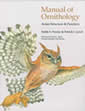
Manual of Ornithology:
Avian Structure and Function
By Noble S. Proctor
|
* |
For
our full recommended reading list, click
here. If you order from
Amazon.com by way of our web site, Majestic receives a
portion of the proceeds! |
Book Description
This book -- a visual guide
to the structure and anatomy of birds -- is one of the most
heavily illustrated ornithology references ever written. A
concise atlas of anatomy, it contains more than 200
specially prepared accurate and clear drawings that include
material never illustrated before. The text is as
informative as the drawings; written at a level appropriate
to undergraduate students and to bird lovers in general, it
discusses why birds look and act the way they do.
Designed to supplement a
basic ornithology textbook, Manual of Ornithology covers
systematics and evolution, topography feathers and flight,
the skeleton and musculature, and the digestive,
circulatory, respiratory, excretory reproductive, sensory,
and nervous systems of birds, as well as field techniques
for watching and studying birds. Each chapter concludes with
a list of key references for the topic covered, with a
comprehensive bibliography at the end of the volume. The
book will be a guide and reference for every level of bird
study - a basic tool for investigation for anyone curious
about the fascinating world of birds.
Reader Poll #13
Question: How did
you find Majestic Waterfowl Sanctuary?
Results of Reader
Poll #12 What is your favorite part of the Majestic Monthly
newsletter?
|
Health Articles |
50% |
 |
|
Predator Articles |
0% |
|
|
|
"All About"
Breed Articles |
0% |
|
|
|
"How To" Articles |
50% |
|
|
|
Updates on Ducks/Geese |
0% |
|
|
|
Featured Books |
0% |
|
|
|
Current Events/News |
0% |
|
|
|
Other |
0% |
Contact Us
Majestic Waterfowl
Sanctuary
17 Barker Road
Lebanon, CT 06249
directorATmajesticwaterfowl.org
Our Newsletter
The Majestic Monthly is published 12 times per year. Back
issues can be obtained online from our
Newsletter Archives.
|
|
Park Rescue
We are so
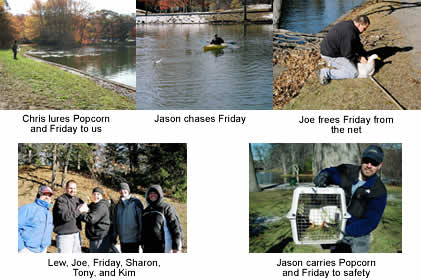
fortunate to have such wonderful volunteers on hand. The Yorks
brought their kayak with them on our final visit to the
Park. Jason chased the last of the Pekins to shore where Joe safely
captured them in a net. Lew, Sharon, Chris and Bill all assisted in
setting up nets, luring in ducks with food and loading ducks into
carriers.
It may be cold, but our
hearts were kept warm as we rescued the last of the Pekin ducks from
the park. We are sincerely grateful for the generosity and devotion
of concerned citizens Chris and Bill who assisted in many vital
aspects of this rescue.
Thank you, everyone!

If you would like to
join our waterfowl rescue team, you can sign up at:
Waterfowl Rescue Volunteer.
Waterfowl Lice
Mites
and lice should not be an issue for you if you are keeping your
ducks in a clean environment with plenty of access to fresh water.
If either of these pests appears, as indicated by excessive
scratching, a visual sighting or vet confirmation, then this should
be treated as a warning that you are not keeping things as clean as
you should be for your ducks. You will need to increase your
efforts.
There are three
common types of lice that can be found on waterfowl:
Head lice
are gray and found close to the skin, near the base of head and neck
feathers.
Body lice
are brown and move around on the skin, commonly on the belly, around
the vent or under the wings. They can commonly be seen running for
cover when you part your duck’s feathers.
Shaft lice
are like small body lice and they tend to hang out on feathers, and
run inwards toward the duck’s skin when feathers are parted.
Lice chew dry
skin scales and feathers. They don’t actually bite the duck, but the
motion of their mouthparts leads to irritation. Mites are different
from lice in that they suck blood. Treatment; however, is the same.
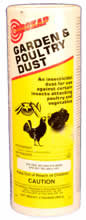
You can
purchase poultry powder at your local grain store. The label should
indicate that it is appropriate for the removal of lice and mites on
ducks. Sprinkle a bit in your hand and work it into the ducks
feathers. Although you want to powder all over (avoiding the well
around the eyes) focus the delousing at the base of the back of the
neck, under the wings and on their underside, especially around the
vent.
Ducks’ feathers
need to be treated very carefully to avoid them from losing their
waterproof effectiveness, so be very careful in administering these
powders and use them sparingly. Delousing powder labels often have
instructions on how to apply them to the duck’s bedding, have never
found this useful since lice die soon after falling off of their
hosts and therefore tend to cling tightly, rather than thriving in
hay or bedding.
If you
discover lice or mites on any one of your ducks, assume they exist
throughout the flock. Treat all flock members according to the
instructions on the label. Be careful not to over do it, so the
animal does not ingest excess amounts of this pesticide.
It is always advisable to double check dosages with your
own vet before administering treatment.
All waterfowl
that come into Majestic receive a careful feather inspection and a
precautionary treatment of poultry dust. We have seen lice die and
fall off within 24 hours of powder treatment. Follow up weekly
treatments at day 7 and day 14, access to clean water and clean
bedding are also necessary until all eggs have hatched and all lice
have been eradicated.
Diurnal Birds of Prey
Eagles,
hawks and falcons are all diurnal raptors—birds who hunt during the
day. If your ducks do not have top cover, they will be at the mercy
of these predators. Most attacks occur on free range ducks,
especially when they are in
open areas with no bushes, trees or houses to provide shelter.
If you see a one of these flying predators near a kill site, it does
not necessarily mean they brought your duck to its demise. You will
need to examine the area carefully in order to determine if the
raptor was the culprit or if they are just a scavenger. Diurnal
raptors pluck out a duck’s feathers before consuming it, so their
beak marks can often be found on the shafts of the plucked feathers.
In addition, if the base of a plucked feather
is smooth and clean, the bird was plucked while warm. If the
feathers have small amounts of tissue clinging to their bases, they
were plucked from a cold bird that died of another cause and the
raptor was just scavenging. Take a look around the site; raptors
will often defecate in the immediate area of a kill they’ve made.
The best
defense against raptors is a well-built enclosure with sufficiently
strong aviary netting on top. Hawks will attack through netting if
they can push down on it far enough to get to your ducks, so choose
your top cover carefully. Guinea fowl will sound an alarm when any
large bird flies overhead, so they can help warn the flock of
incoming trouble. Raptors are commonly seen being chased away by
families or flocks of crows, so another strategy to deter them is to
put out food for your crows to encourage them to settle nearby. This
is a great way of keeping your skies clear of trouble.
All
eagles are federally protected under the Migratory Bird Treaty Act,
which prohibits their possession or destruction. No permits are
required to merely scare them off with your presence except in the
case of an endangered or threatened species, as in the case of the
bald and golden eagles. Check your own state’s laws and regulations
prior to taking any actions against these birds.
Predator of The Month: The
Golden Eagle
We
have decided to feature this next predator to remind duck owners of
the threat that they pose to waterfowl. We have seen a Golden Eagle
here in Lebanon Connecticut, perched upon one of our corner
sanctuary posts two years ago. Fortunately, we have top wire over
our enclosures, so the ducks were completely safe. We would like to
send our deepest condolences to the Connecticut family who recently
lost two of their ducks due to a swift attack of a Golden Eagle. The
raptor dropped down from the sky and made a swift kill before they
could reach their feathered friends.
The Golden Eagle
weighs in between 6 and 13 pounds, with females being larger than
males. We
have seen a golden eagle perched on one of the corner posts of our
aviary. I had never seen or heard of anyone in Connecticut seeing
one first hand prior to that day, which just goes to show you that
uncommon predators can pass through your property and take advantage
of an easy meal. A strong aviary net saved our flock, but we know of
a couple of families who have lost their free range / back yard
ducks to these raptors, not knowing that they were at risk of a
visitation.
|