|
In This Issue...
 |
Consider Life Expectancy Before Adopting |
|
|
Preventing Injuries During Breeding Season |
|
|
Recommended
Reading:
Ornithology |
|
|
Get to Know Your Predators: Domestic Dog |
|
|
Reader Poll #17
|
|
Get to Know
Your Predators: Domestic Dog
Domestic
dogs can weigh anywhere from 2-200 pounds. They are found in
close association with humans nearly worldwide. If you don’t
have a dog, one or more of your neighbors most likely does,
so you will need to keep this potential predator in mind
when building your enclosure.
Dogs range
in temperament from gentle to ferocious depending on nature
and nurture; that is, their breed type and their training.
However, even the kindest pet dog, can turn in a moment of
excitement and cause harm to your duck, even if there has
never been a problem before. For this reason, you should
NEVER leave your dog alone in the company of your duck. We
have heard many stories of wonderful and friendly family
pets suddenly deciding a chase would be fun. When the duck
makes a break for it, the dog gets overly excited and bites
at the duck.
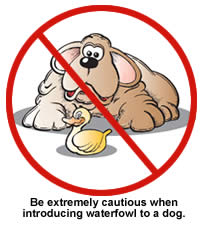
When
introducing a duckling to a trained and friendly
dog, be extremely cautious (aggressive dogs and ducks don’t
mix, so don’t even try it). It is often wise to allow the
dog to smell the duckling from the other side of their pen.
Be sure the dog is in a calm state of mind before the
introduction—as opposed to an excitable or hyper state of
mind.
Dogs are
often known for their jealousies, so be extremely cautious
with your very fragile duckling. As the duck matures and the
dog becomes accustomed to your new duckling, the two should
begin to become friends. Puppies or young dogs should never
be allowed near ducks or ducklings because their playfulness
can easily cause serious injuries or even death.
We
once heard a comment about ducks and dogs. Someone had left
their ducks in their fenced in front yard while they went
into town on an errand. The fencing was by no means predator
proof, just enough to keep the ducks inside. A passing dog
jumped the fence and the ducks could not get away; they were
trapped in their little picket fence, making it even easier
for the dog to bring them to their demise. A terrible story
to remind you that if you are going to put up a fence, you
best put one up that keeps predators out, or you will just
be doing them a favor. A fence that is not high enough will
only trap your ducks inside, at the mercy of the predator.
Build a pen, not a trap for your flock, and never leave your
ducks exposed and unprotected when you are not right there
to chaperone.
Reader Poll
#17
Question: Which
types of fresh eggs have you eaten?
Check all types you have
eaten:
Results of Reader Poll #16 Which
Pekin is your favorite?
|
Donald Duck |
15% |
 |
|
Daisy Duck |
0% |
|
|
|
Aflac |
54% |
|
|
|
Joey's Duck on Friends |
23% |
|
|
|
Howard the Duck |
0% |
|
|
|
Scrooge McDuck |
0% |
|
|
|
Jemima Puddle Duck |
0% |
|
|
|
Huey, Dewey and Louie |
8% |
Contact Us
Majestic Waterfowl
Sanctuary
17 Barker Road
Lebanon, CT 06249
directorATmajesticwaterfowl.org
Our Newsletter
The Majestic Monthly is published 12 times per year. Back
issues can be obtained online from our
Newsletter Archives.
|
|
Consider Life
Expectancy Before Adopting
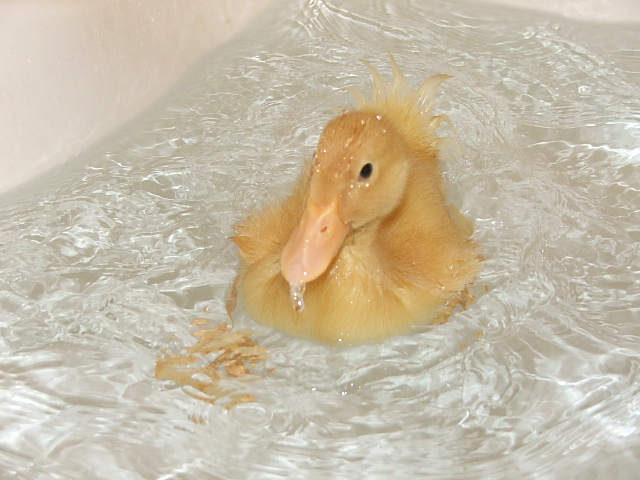
When
adding a duck or goose to your family, remember to take their
lifespan into consideration. Many people mistakenly think that ducks
and geese only live a couple of years. The lifespan of a duck
averages about 8-10 years, with some of them living up to 15 years.
A goose will average about 15-20 years, with some of them living up
to 30 years.
 We are often
contacted by teenagers interested in adopting birds. Our first
question is always, who will take care of the animal when you go to
college? Life changes fast for young folks setting off into the
world. Parents can quickly inherit a couple of pets that they are
not as enthused about as are their children. Parents should take
this into consideration before agreeing that duck/goose ownership is
right for the family. We are often
contacted by teenagers interested in adopting birds. Our first
question is always, who will take care of the animal when you go to
college? Life changes fast for young folks setting off into the
world. Parents can quickly inherit a couple of pets that they are
not as enthused about as are their children. Parents should take
this into consideration before agreeing that duck/goose ownership is
right for the family.
People living in
temporary apartments should also refrain from adopting since their
living situation can change very quickly, leaving animals without a
home. Most of the surrendered animals who come to Majestic come from
apartments. Owners had to find a new place to live and could not
find or afford one that welcomed their duck. Owners are often left
in a desperate situation and have no choice but to relinquish their
beloved pet.
Preventing Injuries
During the Breeding Season
This
is the time of year when drakes are most interested in their hens.
In order to prevent injuries to your drakes and hens (and ganders
and geese), there are a few things to keep in mind.
Flocks avoid most
mating injuries when a single drake is penned with a minimum of
three to four hens.
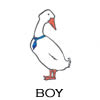 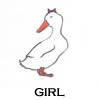
Drake hormones
begin to surge near the end of winter (February). Hormone levels
intensify throughout the spring and summer, leading to overly
aggressive behavior in drakes.
Drakes often
need to be separated from one another to prevent them from fighting
and hurting each other, or from hurting the hens they are competing
over. It is not uncommon for competing drakes to drown the hen they
are vying for.
Hens can be
very easily injured if they are housed with more than one drake, a
drake too large for them, or if a drake does not have enough hens as
companions. Over-mating can lead to serious leg and hip injuries in
hens as drakes mount them on land. Excessive mating can also lead to
oviduct prolapse. This occurs when the oviduct (egg laying tube)
falls outside of a hen’s body while laying her egg.
If your hen has
an always-present bare spot on the back of her neck or has a batch
of feathers missing from under her wings, your drake may not be
giving her the break she needs. Give your hens some time off and
separate them from their drake with a dividing fence, or consider
adding another hen or two to your flock to lighten your hen’s load.
This is obviously only an option if you have the space available to
accommodate added hens; you don’t want to overcrowd your flock.
When
choosing a hen, try to select a girl that is equal to or larger than
your drake. This will help lessen the likelihood of her becoming
injured during mating. A large drake can easily injure or drown a
small hen during mating.
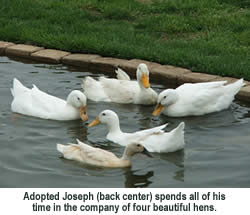
Multiple drake
flocks with no hens can often lead to peace and harmony. Be careful
not to assume that these boys will remain friends if hens are
introduced. Even drakes who were raised up together from ducklings
will quickly turn to rivals when a hen is introduced to a flock—even
if the hen is kept in a neighboring pen out of their reach.
In the fall
(September) and through to mid-winter, drake hormones wane off. At
this time it is sometimes possible for multiple drakes (especially
those who have been raised up together from ducklings) to be
reintroduced and allowed to share enclosures together with hens
without incident.
Recommended Reading*
Ornithology
By Frank B. Gill
|
Ordering information
|
Description:
Frank Gill offers the
most comprehensive, up-to-date look at ornithology available. Not
just a catalogue of species, it takes a conceptual, research-based
approach to communicating an understanding of birds, providing an
interpretive context that gives focus and meaning to the details of
avian life.
Covers the impact of
evolution on birds, especially the integration of morphological,
behavioral, and physiological adaptations; contemporary research on
communication and learning, social behavior, mating and
reproduction, and population and community ecology; and
contributions of avian biology to such fields as ecology,
sociobiology, population biology, and biogeography.
This textbook
is utilized in nearly all college level ornithology classes. It has
been highly recommended to Majestic in response to our inquiries to
veterinarians and college professors all over the country. This
book, in companionship with Noble S. Proctor’s
Manual of Ornithology, Avian Structure and
Function, is a high recommend for duck and goose
owners interested in educating themselves on bird structure and
function.
|
* |
For our full
recommended viewing/reading list, click
here. If you order from
Amazon.com by way of our web site, Majestic receives
a portion of the proceeds! |
|