|
Feeding Your
Waterfowl
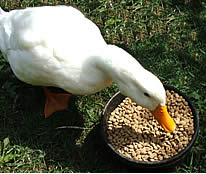 We’ve
been getting quite a few emails asking us what we recommend for
feed. We highly recommend the Mazuri brand of waterfowl food above
all others. The Mazuri line was developed to feed your pets; whereas
other brands are geared more toward farming. You want your ducks and
geese to live long lives with well balanced diets, so you should
have them on a diet that supports their needs. You want to avoid
foods designed for fattening them up for market. Mazuri costs more
than other brands, but you want the best for your beloved pets, so
it is our recommendation to go this route. We’ve
been getting quite a few emails asking us what we recommend for
feed. We highly recommend the Mazuri brand of waterfowl food above
all others. The Mazuri line was developed to feed your pets; whereas
other brands are geared more toward farming. You want your ducks and
geese to live long lives with well balanced diets, so you should
have them on a diet that supports their needs. You want to avoid
foods designed for fattening them up for market. Mazuri costs more
than other brands, but you want the best for your beloved pets, so
it is our recommendation to go this route.
In our opinion, the laying formula
itself is worth its weight in gold. While some laying formulas push
hens to produce a daily egg, taxing their bodies, the Mazuri Breeder
fosters your hens’ needs, supporting them nutritionally throughout
their laying cycles. Without the expectation of hatching out little ones, we recommend
a ratio of 50% Breeder to 50% Maintenance as long as eggs appear
normal.
If eggs appear rough, odd shaped or
soft, then you want to increase their Breeder ratio a little bit
each day until you see a positive change in their egg quality. Once
you have stabilized your hen, and eggs look healthy, you want to
slowly work on decreasing her ration of Breeder again. You want to
find that equilibrium—the point where she gets the maximum benefit
from the least amount of Breeder.
It is not uncommon for hens to
require a higher Breeder ratio in the spring and summer—during the
laying season (this can be true even for those hens who lay eggs all
year long). You may have to feed your hens separately, if some of
them have different Breeder ratio requirements. Non-laying hens,
drakes and ganders should not be fed Breeder formula. It won’t hurt
them if they happen to get into it, but it is not a good dietary
option for them.
 |
Mazuri Waterfowl Starter
(for ducklings and goslings up
to 7 weeks of age) |
|
|
Mazuri Waterfowl Maintenance (for ducks and
geese 8 weeks and older) |
|
|
Mazuri Waterfowl Breeder (for mature laying hens) |
Mazuri has a dealer locator on their
website
www.mazuri.com to help you find a supplier near you.
If you can’t find one, ask your local grain supplier if they will
special order it for you. You may need to order a few weeks in
advance, but it is well worth the effort. We have seen miracles
occur with this food when new rescues come in to our sanctuary.
If you cannot locate the Mazuri or
afford to have it shipped to you, there are other options available
to you:
Blue Seal:
|
|
Blue Seal OrganicLife Starter Crumbles (for
ducklings and goslings up to 3 weeks of age) |
|
|
Blue Seal OrganicLife Grower Crumbles (for ducklings
and goslings 4 weeks and older) |
|
|
Blue Seal OrganicLife Layer Pellets (for mature
laying hens) |
Purina:
|
|
Purina Mills Flock Raiser SunFresh Recipe (for ducklings
and goslings from first hatch through maturity) |
|
|
Purina Mills Layena Sunfresh Recipe (for mature
laying hens) |
*We had a great deal of
difficulty with Purina's Layena formula when we used to use it at our
sanctuary. Many of our hens laid soft shelled, odd-shaped, or rough
eggs while on any ratio of this feed. When we called Purina they
recommended the Mazuri line to us, designed specifically for pets.
We followed their recommendation and have had tremendous results.
If your ducks and geese have access
to the great outdoors, they will get their grit from the ground. If
they don’t have access to the dirt and sand which they eat and grind
food with in their gizzards, then you want to purchase a bag of grit
from your local grain store. This should be made available to them
24/7.
Laying hens should have access to a
calcium source 24/7. You can purchase oyster shells or calcium chips
from your local grain store. This should not be mixed in with their
regular food. Place it in a different feeder. Your hens have the
instincts to know just how much and when to eat this supplement. If
you mix it with their food, you can throw them off.
Another great source of calcium is
to hard boil your hen’s eggs, chop them up and feed them back to
them—shells and all.
Grazing
If
your pens aren’t grassy and large, grazing is a great idea. Open the
door and take your friends for a walk in the yard. It’s good for
them and fun as well. They will eat greens and forage for bugs in
the grass. This is all added nutrition for them and will make your
animals that much healthier.
Be sure to keep your ducks and geese
away from any treated areas of your lawns, and remember toxins have
a tendency to move with rain and tread.
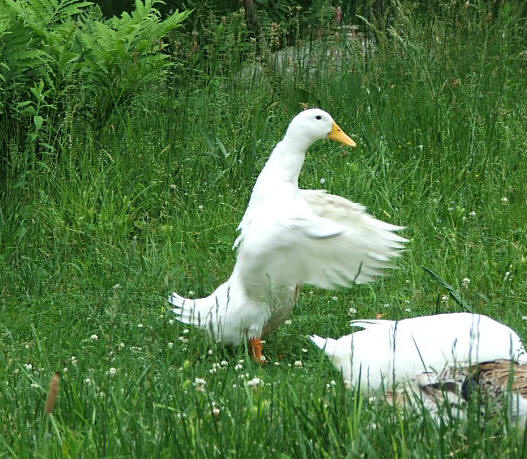 Ducks
and geese should always be chaperoned during free range excursions.
Predators are quick, especially around this time of year as food
supplies diminish. Watching from the window is not the best option
since we have heard from many of you who have lost flock members
this way. It is nearly impossible to run down a fox, dog or coyote
on the run and you are incapable of following a hawk, owl or eagle.
Your presence with your flock members is what keeps these trouble
makers away when your ducks and geese are outside of their
enclosures. Ducks
and geese should always be chaperoned during free range excursions.
Predators are quick, especially around this time of year as food
supplies diminish. Watching from the window is not the best option
since we have heard from many of you who have lost flock members
this way. It is nearly impossible to run down a fox, dog or coyote
on the run and you are incapable of following a hawk, owl or eagle.
Your presence with your flock members is what keeps these trouble
makers away when your ducks and geese are outside of their
enclosures.
When grass fades it is a great idea
to add greens to your flock’s diet. Please see our
April 2005 Newsletter regarding
foods you should avoid feeding your feathered friends.
Drake Hormones
on the Decline
Hormone levels in the drakes are on
the decline, and what a relief! Hormone levels drop noticeably in
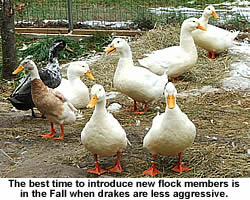
September and virtually disappear in October. The Fall is the best
time of year to introduce new flock members. Drakes are less prone
to fighting with each other and with newcomers at this time of year.
If you separate your drakes and hens
during the mating season to give your hens a much deserved rest, you
can slowly work at reuniting them now with a much reduced risk of
over-mating. The love craze slowly tapers off and peace among the
flock often resumes for a few months anyway (the “fun” usually
resumes around February).
We keep all of our alpha drakes in
separate quarters, most with at least one companion, and all with
plenty of neighbors in adjacent pens. In October we usually begin
taking steps to rejoin the majority of the drakes together. This is
done by releasing a single alpha drake and all of his drake
subordinates into our Courtyard pond—we try to choose a cold day to
do this, so they are less feisty. Then, we release a second alpha
drake into the area without his drake subordinates. Once the drakes
work out their hierarchy and peace is achieved, we give them a few
minutes to relax before releasing the second alpha drake’s
subordinates, one at a time. These scuffles are usually less intense
than the alpha struggles. We continue in this manner, releasing an
alpha duck and then one-by-one releasing his subordinates, for as
long as the general peace remains or until we have our flock sized
and shaped accordingly. We are always equipped with wading boots and
a long pole in preparation should we need to break up any drakes,
but it rarely comes to this.
Sometimes this process needs to be
stopped part way through and picked up again later, especially when
introducing a number of alpha drakes. But most often, it can be
completed on a Saturday morning and the newly formed flock can be
monitored over the course of the weekend.
If any of the alpha drakes cannot
work it out, they will need to remain separate from each other.
Avoid leaving alpha drakes alone while they struggle for alpha
dominance or injuries may result. Keep a close eye on the drakes for
1-2 days, checking on them frequently to be sure that peace is
maintained. When in doubt, separate.
|