|
Pekin Duck
Mini-Clock!
We
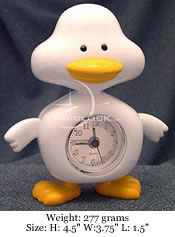
ordered a handful of these Pekin mini clocks as holiday gifts
for a few of our duck-loving friends. This fantastic Alarm Clock
is in the shape of a super cute, happy duck, and it is bound to
make a great gift! It is a solid piece of high quality metal (no
plastic) with a white and orange enamel finish. The compact
clock and alarm settings are recessed into the back of the duck.
You can order this and other
delightful clocks at
MiniClocks.com. Their
customer service is exceptional. When placing your order tell
them Majestic Waterfowl Sanctuary referred you.
Get to Know
Your Predators:
The Opossum
The
Opossum weighs in anywhere between 4 and 12 pounds depending on
gender. Opossums are nocturnal and are generally interested in
eggs, but they will take a duckling and even an adult duck if the
conditions are right—if they are hungry enough.
Opossums are nocturnal and can often be deterred with motion sensor
lights or a good dog. Pick up eggs daily to avoid luring them in.
Reader Poll
#26
Question:
What behavioral problem(s) are you currently experiencing
with your waterfowl?
(Check as many as you like)
Results of Reader Poll #25
What would you
like to accomplish in 2007?
|
Build a new/better enclosure |
15% |
|
Acquire more geese/ducks |
18% |
|
Resolve a predator problem |
24% |
|
Learn more about waterfowl |
10% |
|
Build a new/better pond |
13% |
|
Downsize my flock |
10% |
|
Help waterfowl in need |
10% |
Contact Us
Majestic Waterfowl
Sanctuary
17 Barker Road
Lebanon, CT 06249
directorATmajesticwaterfowl.org
Our Newsletter
The Majestic Monthly is published 12 times per year. Back
issues can be obtained online from our
Newsletter Archives.
|
Majestic Kittens
Bridget and Timmerlane This
summer Majestic embarked upon a two kitten rescue. The Link
family adopted two kittens from our local humane society and
brought them out to our duck barn. We placed Bridget and
Timmerlane in their own kennel in clear view of our feathered
friends. This gave the girls time to get used to the sight of
ducks, and it gave the ducks time to adjust to their newest
flock members.
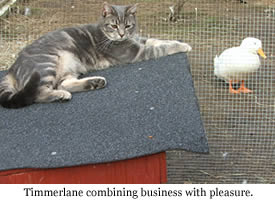
Although the kittens receive plenty of
human interaction; the bulk of their days are spent in the
company of the flock. They are bonded with the ducks and think
of them as part of their family group and the ducks have
similarly become very accustomed to the presence of their new
pen mates.
It didn’t take long for the ducks to
realize they have the upper hand in this new situation (the
geese never doubted it). We laughed when we saw Riddles, our
adoptable little Indian Runner, chase after Timmerlane after her
curiosity brought her in a bit too close for his comfort.
Balance between ducks and kittens was obtained within a few
weeks and we are currently thrilled to see Bridget looping her
tail around Winston as she brushes against him.
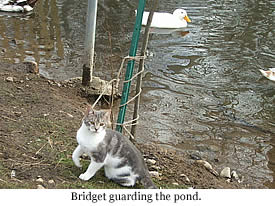
As the kittens grew, we installed three
pet doors and multiple catwalks to give them access to all areas
of the barn and outdoor enclosures.
The girls have been introduced to our
sanctuary to do very important work. They will help defend the
flock against the occasional food-thieving rodent or squirrel
that happens through the pens or barn looking for a free meal.
The growing cats are also an excellent deterrent against
weasels. In addition to their hunting tasks, the girls spend
plenty of their days chasing one another throughout the pens,
lounging around on the roofs of duck houses and nestling in the
hay for naps.
Frostbite
 Frostbite
is a real hazard for domestic ducks and geese during freezing
cold temperatures. Feet and bills are vulnerable to extreme cold
and real damage can be done if they are not properly protected. Frostbite
is a real hazard for domestic ducks and geese during freezing
cold temperatures. Feet and bills are vulnerable to extreme cold
and real damage can be done if they are not properly protected.
Although ducks and geese control the
blood circulation to their legs and feet in order to avoid the
loss of too much heat, there is only so much their bodies can do
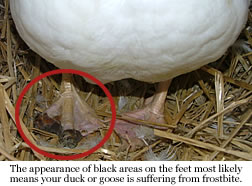
when the elements grow too harsh. The appearance of black areas
on their feet is a clear indicator that your bird is most likely
suffering from frostbite.
Waterfowl with frostbite need to be
brought to a veterinarian for treatment as soon as possible.
Treatment often involves the cutting away of damaged tissues and
sometimes even a partial amputation.
Prevention is the key when it comes to
the cold elements. Trust your instincts—if you think it’s too
cold out for them and you see ice forming on their feathers, or
ice encroaching in on your pond, this can be a clear sign that
your waterfowl need to spend more time in the comfort of their
barn or shed. Also, if you see flock members spending too much
time sitting on top of their feet and not moving, it is
advisable to bring them into a cozy barn or shed where they can
meander around a bit. Use your good judgment and control the
time they spend outside. For their protection, it is best to
keep your feathered friends inside during freezing rain, ice
storms and single digit (or below) temperatures.
Thank you to
Michelle for the photograph of the rescued Muscovy duck.
Metal Detector
Needed
 Do
you or someone you know have a metal detector lying around
unused? Consider donating it to Majestic to help us routinely
examine our grounds for foreign metal objects. Your donations
are tax deductible! Please contact us at
directorATmajesticwaterfowl.org
if you can be of assistance. Do
you or someone you know have a metal detector lying around
unused? Consider donating it to Majestic to help us routinely
examine our grounds for foreign metal objects. Your donations
are tax deductible! Please contact us at
directorATmajesticwaterfowl.org
if you can be of assistance.
Recommended
Reading*
|
|
Ordering
information
|
Book Has Both English &
Spanish Language Text
|
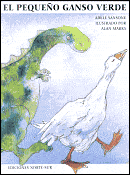
El Pequeno Ganso Verde
(The
Little Green Goose)By
Adele Sansone
The lone gander on a farm longs
to be a father. After all the hens refuse to donate an
egg for him to care for, the farmhouse dog finds a
large, apparently abandoned egg, which the gander
adopts. The small dinosaur that hatches is perfectly
happy with his gander "mother" until the chicks point
out that the two of them look nothing alike. And thus
begins the baby's search for his "real" mother.
|
|
* |
For our
full recommended reading list, click
here. If you order from
Amazon by way of our website, Majestic receives a
portion of the proceeds! |
|

 Majestic Kittens Bridget