|
Geese and Home
Security
Guard geese are
snapping at the heels of would-be burglars across back yards as
home owners embrace them as family pets. Famous for saving the
Roman Empire from a surprise attack by the Gauls in 365 BC,
geese are still helping to patrol properties today.
Some sources say that
if you have a goose in your yard rather than a dog a robbery is
less likely to occur in your home. Why? Potential invaders know
that geese are likely to sound the alarm and because they are
notoriously known to attack trespassers. Deafening shrills and
the threat of attack by territorial geese that can weigh up to
26 lbs. and have bills like serrated-edged knives is threat
enough to keep some trouble at bay.
The alarm a goose
sounds is very different from its other calls. It is loud and
piercing. While neighbors may ignore a barking dog, they are
likely to look out the window when they hear this distinctive
alarm.
Get to Know
Your Predators:
Raccoon
Raccoons weigh around thirty pounds. They prefer to do most of their
dirty work in darkness; however, they can sometimes be seen during
the day.
The
number one thing that raccoons do is look for food, so do not
underestimate the determination of this crafty predator. They are
lured in by duck food and the ducks themselves. They are very good
problem solvers and excellent lock picks. I can remember a few
occasions as a youngster when a raccoon let our chickens out while
getting at the grain. Padlocks, thankfully, are beyond their
capabilities.
Raccoons are capable of tearing and biting through aviary netting
and poultry fencing to get at your ducks. A raccoon will employ
every tactic at its disposal to get at your flock. Worst of all,
raccoons have been known to eat a duck right through the fencing if
they can get their paws on any part of the sleeping bird.
Recommended
Reading*
|
Ordering Information
|
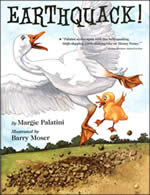
Earthquack!
By Margie
Palatini
Henny Penny's
sky-is-falling tale has been retold often enough that few probably
even remember its source material--but that doesn't stop another
retread, this one surprisingly conservative in its story-telling
liberties, by Margie Palatini (The Web Files) and dignified
illustrator Barry Moser.
Earthshaking
rumblings make for a skittish duckling (and other nervous farm
animals) in this somewhat long-winded variation on the Henny Penny
theme. After completing his morning laps, a jittery Chucky Ducky
fervently attempts to warn the other skeptical and pun-fully named
animals (e.g., Lucy Goosey, Sue Ewe, Billy the kid) of what he's
sure is an earthquake (He heard the ground grumble. He felt the
ground rumble). Oh, it can't be that baa-ad, retort the lambs while
the pig grunts, Hogwash! Several lengthy episodes of earth crumbling
and animal tumbling pass before a hungry weasel (sporting a white
coat and masquerading as Herman Ermine) provides a refreshing detour
and real tension to the story.
|
* |
For
our full recommended reading list, click
here. If you order from
Amazon by way of our website, Majestic receives a
portion of the proceeds!
|
Reader Poll
#31
Question:
Which part of the Majestic Monthly do you most often read
first?
Results of Reader Poll #30 Question:
Which are funnier to watch, ducks or geese?
Contact Us
Majestic Waterfowl
Sanctuary
17 Barker Road
Lebanon, CT 06249
directorATmajesticwaterfowl.org
Our Newsletter
The Majestic Monthly is published 12 times per year.
Previous issues are available in our
Archives.
|
Breaking Ground on
Louisville
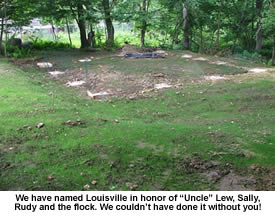
Thanks to your generous donations, we have
broken ground on Louisville! The underground fencing for this
pen has been placed 4 feet down into the ground. Construction on
the structure itself will take place in July, and we hope to
have it complete and useable by early August.
More funds are needed to complete this
project, so if you have not donated, please consider doing so—we
really need your help! If we have helped you with your flock,
consider returning the favor by helping the ducks and geese here
as well as those waiting for enough space to come into our
sanctuary. We are a do-it-yourself team here at Majestic, which
means even the smallest donation goes a long way.
The Refilling
of Pekin Pond
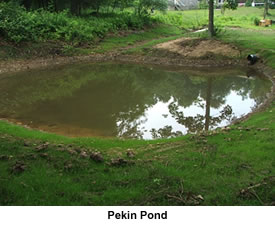
Neighboring Louisville is Pekin Pond, and
we are happy to announce it is a pond once again! The pond bed
has been empty for years. The stream that once fed and filled
this basin had slowly carved out a more direct path down the
property that left the pond to dry up and become overgrown with
brush and trees. We have worked on clearing the pond bed for
nearly a year in order to bring it back to life. While we had
the excavator on hand for Louisville, we used it to set the
stream back to its original bed again. Pekin Pond is now full
and beautiful once more!
If you
would like to help breathe life back into Pekin Pond, consider
making a plant donation. We can really use some plants to
naturalize the waterscape: hardy water lilies, hardy lotus,
pampas grass, bamboo, rice and cattails are some great ideas. If
you live locally and can bring any of these items by, just send
us an email and let us know when you would like to stop in for a
visit. If you don’t live locally and would like to donate pond
plants, you can order plants from William Tricker Inc:
www.tricker.com. All plants donated must be
non-toxic, perennial and must be hardy enough to survive our
Zone 6 winters. Thank you!
Special Thanks
We would like to extend a special thank you
to Sean and Jeff for coming out again to volunteer. With their
help we were able to complete the installation of our patio
misting system, which cools the waterfowl in The Courtyard. Next
time we promise not to step on your fingers while you hold the
ladder—sorry! Thank you for your continued generosity and
support and for taking us out to dinner. You are too kind for
words.
Happy Birthday, Jeff!
Special Thanks
IIWe would
also like to extend an extra special thank you to Richard.
Richard just celebrated a birthday as well, and in lieu of
accepting gifts from his family and friends, he asked that
donations be made towards our sanctuary. Richard came to the
sanctuary with his family to personally present us with a check
for $200!
Richard, it is a very
rare person who gives so selflessly, especially at your age. We
are astounded by your generosity and thoughtfulness. It was such
a pleasure meeting you and your family. We hope you enjoyed the
tour of our sanctuary. Thank you most sincerely, and do come
again.
Majestic Geese
Need Homes
We need wonderful homes for our rescued geese! We have six at
Majestic and two more waiting for enough room at our sanctuary
to come in. All of them need homes with swimming accommodations,
fenced in yards and a nighttime lock up for safe sleeping.
If you are interested
in adopting a pair of geese from us, it is important to
understand that when you arrive at the sanctuary they will sound
the alarm at you! You will not be able to witness the level of
interaction we experience with them because you are unknown to
them. Geese are not very trusting of strangers, but don’t worry;
you will soon establish a similar relationship with them once
they are in their new home with you. Changes in their demeanor
are evident within the first couple weeks of ownership. As with
many animals, this relationship continually improves with time,
routine and commitment to their care.
Tutter and
Angelo: Toulouse Ganders
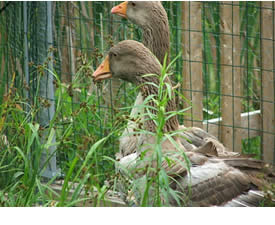 These two boys are
very interactive and extend a loud greeting when they see humans
approaching! Tutter runs up to greet us with Angelo right behind
him. When we move around the outside of their pen, both boys
follow us along the fence line. Tutter allows some petting once
you earn his trust, while Angelo stands back a foot or two and
observes. Both boys love interactive play. One of their favorite
pastimes is snorkeling in colored cups of water. These are high
energy geese who would do better in a home without small
children. Tutter & Angelo are happy to swim in a kiddie pool or
two. These two boys are
very interactive and extend a loud greeting when they see humans
approaching! Tutter runs up to greet us with Angelo right behind
him. When we move around the outside of their pen, both boys
follow us along the fence line. Tutter allows some petting once
you earn his trust, while Angelo stands back a foot or two and
observes. Both boys love interactive play. One of their favorite
pastimes is snorkeling in colored cups of water. These are high
energy geese who would do better in a home without small
children. Tutter & Angelo are happy to swim in a kiddie pool or
two.
Ali and
Chan: Pilgrim Gander and White China Gander
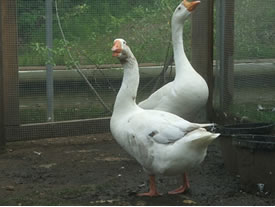 These two boys are a
bit naughty—but so completely wonderful! They are very smart and
learn a new routine within a day or two. They will go wherever
you guide them. If we have lettuce treats Chan will come very
close, but has not quite succumbed to eating out of our hands
yet. Ali is a jealous protector of his best pal Chan, and
watches humans very closely to be sure his friend is safe. These
big, beautiful boys both prefer to move away from humans when
approached rather than attack, but if cornered, both will hiss
and Ali may charge. If we call Ali’s bluff, and react by
charging at him, he will quickly back down and move away. These two boys are a
bit naughty—but so completely wonderful! They are very smart and
learn a new routine within a day or two. They will go wherever
you guide them. If we have lettuce treats Chan will come very
close, but has not quite succumbed to eating out of our hands
yet. Ali is a jealous protector of his best pal Chan, and
watches humans very closely to be sure his friend is safe. These
big, beautiful boys both prefer to move away from humans when
approached rather than attack, but if cornered, both will hiss
and Ali may charge. If we call Ali’s bluff, and react by
charging at him, he will quickly back down and move away.
Ali & Chan need a home
with a family who are not-so-interested in close interaction
with them as they are in granting a few abandoned animals a
life-long place to stay. A true animal-lover would enjoy the
sight and sound of these gorgeous ganders. These geese tend to
only make noise when humans approach. They would do better in a
home without small children. They are low maintenance geese,
requesting very little of your attention outside of providing
them with their basic necessities. Ali & Chan require a minimum
of a small pond for swimming.
Bowie and
China Girl: Toulouse Gander and White China Goose
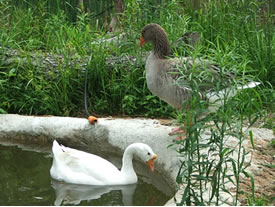 Bowie and China girl
are very sweet and soft spoken. They do make some noise when
humans approach, but not as much as the others. They are
pleasant geese who are a bit shy, but will slowly come around to
your attention. Both are easy to herd and are quick learners. Bowie and China girl
are very sweet and soft spoken. They do make some noise when
humans approach, but not as much as the others. They are
pleasant geese who are a bit shy, but will slowly come around to
your attention. Both are easy to herd and are quick learners.
Bowie will fluff his
feathers in display when he first meets you, but his threats
stop here. Once he gets to know you, he no longer does this.
China is just beginning to walk up and investigate us. China is
also an egg-layer. Both have shown the beginning of interest in
play activities and enjoy examining new and colorful objects
shown to them. These geese would work out well with a family
with small children. This pair is content to swim in a kiddie
pool or two.
If you are interest in
adopting any of these pairs of geese, please fill out our
online adoption application
and email us digital photos of your goose pen.
|

 Breaking Ground on Louisville