|
In This Issue...
 |
Pet
Rock Festival 2005 |
|
|
One Year Anniversary |
|
|
Our Webmaster |
|
|
Kentucky Rescue |
|
|
Your Medicine Cabinet |
|
|
Hardware Disease |
|
|
Our Wish List |
|
|
Duck Characteristics |
|
|
Get to know your predators:
Norway or Brown rat |
|
|
The Month in Photos! |
|
|
Recommended Reading:
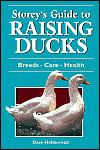
Storey's Guide to Raising Ducks |
|
|
Reader Poll #10
|
Have you seen
our Wish List?
Our Wish List contains items we regularly need such as feed, hay,
cement, wood, fencing materials, hoses, and heavy duty equipment.
Stop by
Our Wish List
for a "look see." If you can help with any items on the list,
please
contact us!
Duck
Characteristics
We have new icons on our adoption page to help potential adopters get
to know the ducks and geese in need of homes. To see the new
descriptors, view the
Adoption Profiles.
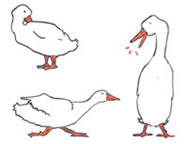
From L-R:
Shy, Nervous, and Vocal
Get to Know
Your Predators: Norway or Brown Rat
If you see one, there are
probably a few dozen more hiding in the shadows . . .
Brown
Rats weigh in at about eleven ounces. In prime
conditions, where there is plenty of food, rats will
multiply very rapidly. They can have up to fourteen
young every twenty days, and they are able to reproduce
within two months of being born. They can fit through an
opening the size of a quarter, leap up to three feet in
the air and climb walls.
Rats eat eggs, can kill small ducklings, harass larger
ducks and spread diseases. Despite all this, it is nearly impossible to build a rat-proof enclosure. They
will literally burrow under and around enclosures and
barns and chew their way through and into buildings to
get at stored grain. They will literally tear down the
barn around your ducks in order to get inside (which can
create passages for other predators). Every effort
should be made to exterminate them the instant they are
found on the premises.
Discourage rats by storing your duck grain in metal
containers.
Metal
flashing can be mounted over base boards to keep rats
from chewing through them, but ultimately, the aid of a
few good cats is your best deterrent.
Carbon monoxide scented &
tinted-smoke
bombs placed into burrows that are then sealed closed
(from all entry points) are an excellent means to wiping
out an entire colony. Continue with this tactic until no
more holes are found and the telltale signs of the
rodents are completely gone.
The Month in
Photos!
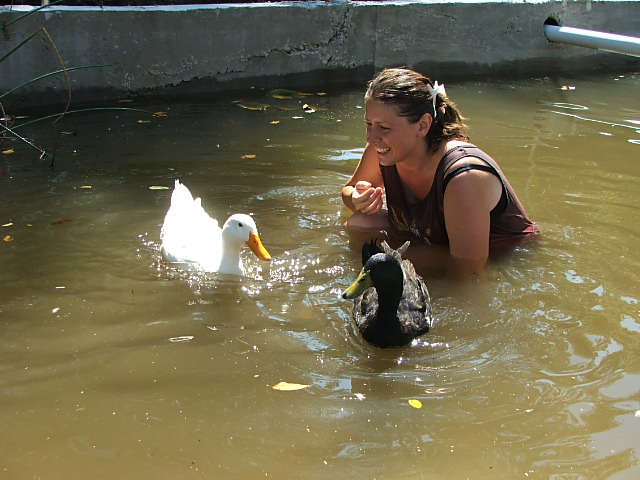
In the pond with Matt & Jeff!
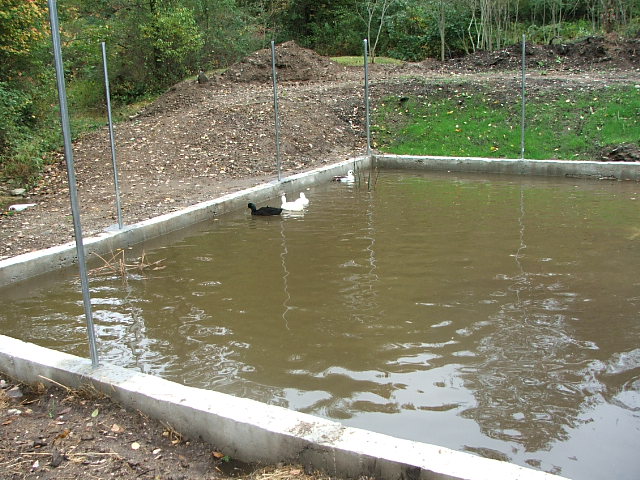
The new pond is FULL!
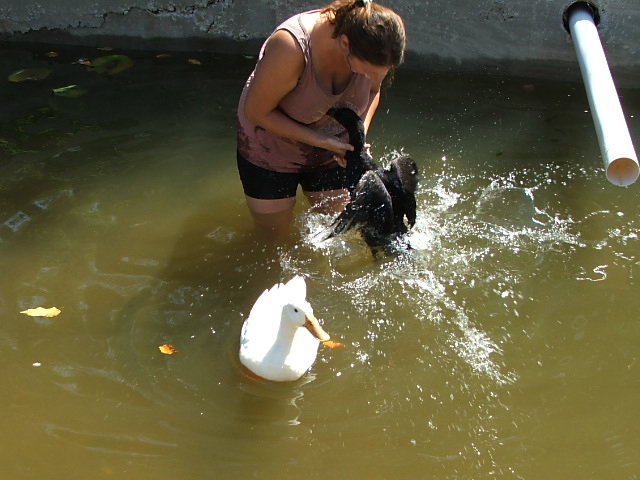
Winston jumps up!
Recommended
Reading*
|
Ordering
information |
Storey's Guide to
Raising Ducks
By Dave Holderread
|
* |
For
our full recommended reading list, click
here. If you order from
Amazon.com by way of our web site, Majestic receives a
portion of the proceeds! |
Book Description
This book includes
information on selection, housing, space requirements,
breeding and hatching techniques, feeding, behavior, and
health concerns and remedies for illness. The authors were
chosen not only for their expertise but also for their
ability to explain the ins and outs of animal husbandry in
an inviting and authoritative manner.
Whether readers are ready
to start an entire flock or are considering purchasing their
first animal,
Storey's Guide to Raising Ducks
is an indispensable reference and is jam-packed with
information available nowhere else.
Note: This book
contains sections on butchering as well as duck recipes.
Reader Poll #10
Question: Which book
on waterfowl do you most often use/refer to?
Results of Reader
Poll #9 What brand
of feed do you give your waterfowl?
|
Purina |
33% |
 |
|
Mazuri |
33% |
|
|
|
Blue Seal |
17% |
|
|
|
Other |
17% |
| |
|
Contact Us
Majestic Waterfowl
Sanctuary
17 Barker Road
Lebanon, CT 06249
directorATmajesticwaterfowl.org
Our Newsletter
The Majestic Monthly is published 12 times per year. Back
issues can be obtained online from our
Newsletter Archives.
|
|
Pet Rock
Festival 2005
We
dare say Majestic and
our ducks
were the hit of Pet Rock!
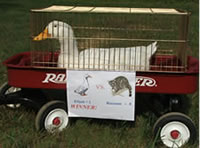
We entered Elijah in the adoptable pet parade and pulled him along
in a red Radio Flyer wagon.
 We
distributed informational brochures, sold all of our plush Majestic
ducks, and gave away paper crowns to the kids. Our royal subjects
were everywhere! We
distributed informational brochures, sold all of our plush Majestic
ducks, and gave away paper crowns to the kids. Our royal subjects
were everywhere!
People were
surprised to learn that domestic ducks and geese do not fly and
cannot escape the ponds they are abandoned to. Getting that message
out to a few thousand visitors is one of the best ways to help our
endeavor to prevent waterfowl drop offs.
Young Matthew and
Elijah slept all the way home, but immediately quacked up a storm
upon being reunited with their flock. We could hear them telling
their flock mates about their adventures as we closed the barn door
after tucking them in for the night.
We would like to
sincerely thank Karen of
Cathy’s Rottweiler Rescue and
Paula and Tom of the
House Rabbit Connection for
volunteering their assistance at our booth when the crowd was at its
peak.
One Year Anniversary!
 As
we reflect on our first year anniversary, we review the goals we had
set for ourselves and set our new goals for the coming year. As
we reflect on our first year anniversary, we review the goals we had
set for ourselves and set our new goals for the coming year.
With the help from
our volunteers, Lew and Bill, we became incorporated in May of 2005
and were approved for tax exemption in September. With our tax
exemption approved, we plan to seek out corporate funding to expand
our sanctuary and build even more enclosures for ducks and geese in
need of shelter.
We poured the cement
walls and pond basin for our new sanctuary and have raised enough
funds to order our fence supplies and put up our perimeter fencing.
We will continue to raise funds to purchase an aviary netting to
complete the new sanctuary. When the sanctuary is complete, we are
looking forward to our Grand Opening!
We have assembled a
respectable waterfowl Vet Finder on our site. The New England states
are complete and we plan to expand this listing westward over the
course of the next year.
We were surprised to
discover how many families were in need of advice and information on
how to care for their waterfowl over the past 12 months. For this
reason, we plan to increase our role as educators over the next year
by completing a guidebook with the answers to the most frequently
asked questions regarding waterfowl care. We also plan to continue
to appear at pet stores and pet events to make ourselves available
to the public.
Most importantly, we
have listed nearly 40 ducks on our site for adoption and placed 27
of them into wonderful and loving new homes. We have also helped
find homes for a handful of ducks and geese that were residing at
Nevins Farm Sanctuary in Massachusetts. We have said hello and
good-bye to many birds over the course of the last year, farewells
that were both bitter and sweet. We look forward to another year of
rescuing and finding homes for even more of these abandoned animals.
It has been an added blessing to make so many new friends through
our endeavor, and we thank all of you for your kindness and support.
You are all an inspiration, and we look forward to another wonderful
year together.
Our Webmaster
As
we come upon our first year anniversary, we begin to reflect on the
near 40 ducks that we've helped find homes for in the last 12
months. We have made some very good friends along the way and would
like to thank all of them. We especially want to take a minute and
stop to thank our Webmaster, Abby Garcia.
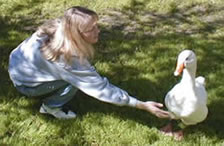
Abby volunteered to
build our website a year ago when we first began our rescuing
endeavor and felt we were in way over our heads. She stuck by us and
helped guide us through some difficult and trying decisions. She has
proved to be an invaluable member of our team and a true resource of
information. We simply could not have done so much and helped so
many without her involvement in this project.
Although we reside on
opposite coasts, Abby keeps in contact with us on a near daily
basis. She tirelessly updates and keeps our website current. She
puts together all of our articles and photos and arranges them into
our monthly newsletters along with a few articles of her own. She
maintains our e-list and formats and forwards our messages out to
the group, so that everyone is up-to-date regarding our progress. In
addition to a myriad of unbelievable tasks, including web site
design (and our beautiful banner!) and maintenance, she created all
of the forms on the site, compiled most of the links, and helped us
put together a gorgeous brochure.
Abby is an amazing
and generous person, and she makes sure important and helpful
information is available to everyone who visits our site. She is our
invisible partner who helps you ask us questions and get responses
by ensuring that the site is functioning properly.
Thank you, Abby, for
being on our team and doing so much for the ducks and geese out
there who need our help! Thank you also for everything you have done
for us, through such a trying year -- you are so appreciated! We
look forward to many more wonderful years of rescuing together!
Kentucky Rescue
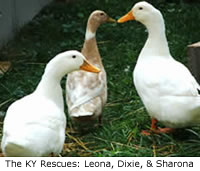
A journey to Kentucky to
visit Jonah, Joseph and Fiona in their new home with Qwaka was more
than just a social visit. It was wonderful to see these ducks
enjoying one another’s company in their gorgeous predator-proof
enclosure, and escorted swims to their pond. Visits are not only
about ducks adopted, but also about ducks in need of rescue.
We
would like to thank the Huffmans for their assistance in rescuing
three hens abandoned to a local Kentucky pond, dangerously close to
an intersection. The three girls have joined the Huffman flock and
the Huffman’s have decided to join our volunteer flock. Their photo
and bios have been added to our
staff listing.
A Well-Stocked Medicine
Cabinet
In
addition to having a pet carrier on hand and a vet on call, be sure
to stock your medicine cabinet with these invaluable emergency
items:
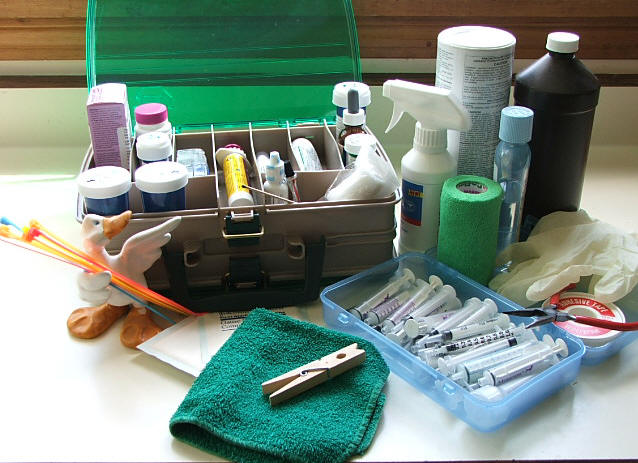
 |
A blood
coagulant in case of a toenail break. |
|
|
Bandages and gauze
tape in case of a foot, leg or wing injury. |
|
|
A towel and
clothes pin to blanket your duck's eyes and calm them during
emergency procedures. |
|
|
Needle nose
pliers for plucking a broken blood feather. |
|
|
An antiseptic
or wound wash. |
|
|
Disposable
rubber gloves |
|
|
Oral syringes
for administering medication, liquids or food. |
|
|
Bacitraycin
Antibiotic ointment |
|
|
Vetropolycin
antibiotic eye ointment |
|
|
Baytril (22.7 mg
antibiotic pills) for weekend/after hour emergencies. |
|
|
A Saline
Solution for Sensitive Eyes to flush out eye
injuries. |
|
|
Poultry powder
for the treatment of lice and mites. |
|
|
A bottle of
hydrogen peroxide. |
|
|
A spray bottle
to put the prepared hydrogen peroxide/water solution into
for misting and washing out any boo-boos to help stave off
infection (10% H.P. to 90% water). |
Always consult your vet immediately in the case of an emergency or
accident!
Hardware Disease
Ducks
and geese are highly prone to Hardware Disease. It is one of the
number one killers of pet waterfowl. Shiny objects appeal to ducks
and geese and invite investigation. They ingest these tid-bits
completely unaware that they may have just sealed their fate.
Screws, nuts, bolts,
nails, staples, bits of wire, hooks, coins, pins, shreds of aluminum
foil, jewelry--these are just some examples of items that can end up
inside your pet's body, seeping into their bloodstream. This
poisoning is known as Hardware Disease.
Although there are
symptoms, but the time they appear, it tends to be too late to help
your duck.
If your
duck displays any of these symptoms, take them to the vet
immediately for an x-ray and blood test to check for traces of
metal.
Although
Hardware Disease is extremely difficult to treat, it is entirely
preventable. Make weekly inspections of your waterfowl enclosures,
barns and pools. Search for and remove any small metal objects that
can be picked up by your ducks.
In
addition to visual inspections, we highly recommend that grounds be
periodically swept with a metal detector. This is especially
relevant when any building or maintenance projects are underway or
have been completed. Sweep any area your ducks have access to as
well as any outer-lying property (to avoid objects being tracked or
washed in). Avoid visitors entering your your duck pens with
jewelry--earrings and pendants can be deadly if dropped.
Do not
run lawn mowers, weed-wackers or chainsaws in the vicinity of your
ducks. These power tools can toss metal bits and objects right
through your fencing and into your pens.
|